What Do Eye Drop Cap Colors Mean?
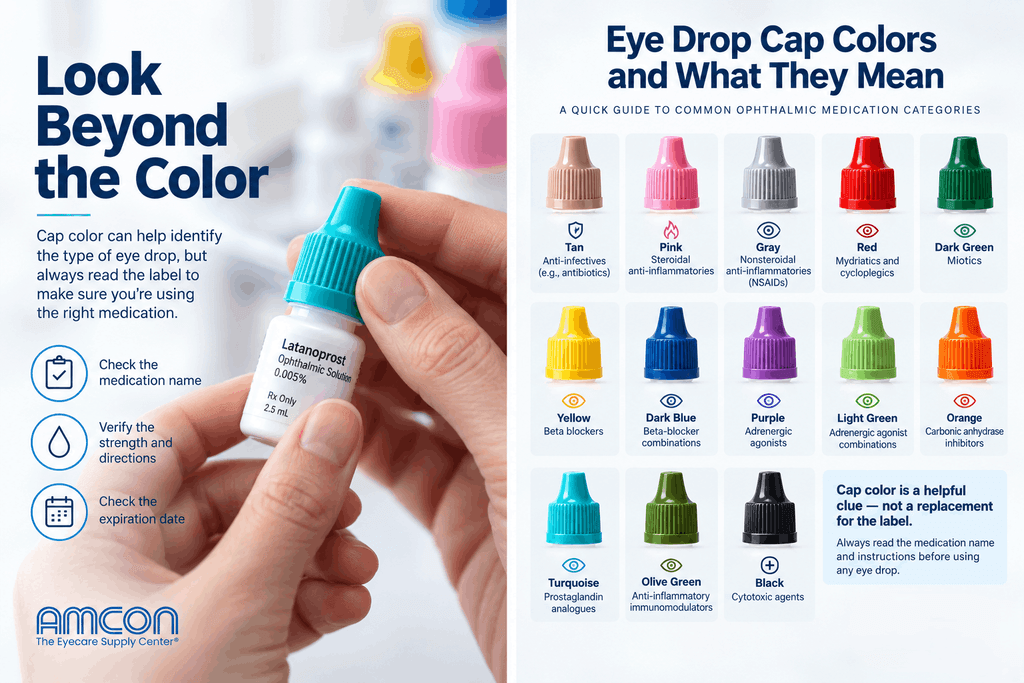
Eye drop cap colors are used to help identify the therapeutic class of many prescription ophthalmic medications. The American Academy of Ophthalmology (AAO) developed a uniform color-coding system for topical ocular medications, and the U.S. Food and Drug Administration (FDA) recommends that manufacturers follow this system.
Here is a quick reference guide:
| Eye Drop Cap Color | Medication Type |
|---|---|
| Tan | Anti-infectives |
| Pink | Steroidal anti-inflammatory medications |
| Gray | Nonsteroidal anti-inflammatory drugs (NSAIDs) |
| Red | Mydriatics and cycloplegics |
| Dark Green | Miotics |
| Yellow | Beta blockers |
| Dark Blue | Beta-blocker combinations |
| Purple | Adrenergic agonists |
| Light Green | Adrenergic agonist combinations |
| Orange | Carbonic anhydrase inhibitors |
| Turquoise / Teal | Prostaglandin analogues |
| Olive Green | Anti-inflammatory immunomodulators |
| Black | Cytotoxic agents |
These colors indicate a medication category, not necessarily one specific drug.
Why Are Prescription Eye Drop Caps Color-Coded?
The color-coding system is intended to make different classes of ophthalmic medications easier to distinguish.
This can be particularly useful because a patient may use several prescription eye drops at the same time. Instead of every small ophthalmic bottle looking nearly identical, different cap colors provide an additional visual cue.
For an eye care professional, phrases such as “the yellow-cap drop” or “the orange-cap drop” may also help during a conversation about a patient’s medications.
However, cap colors are an identification aid rather than a replacement for the medication label.
What Does a Tan Eye Drop Cap Mean?
Tan caps generally identify anti-infective eye drops.
This category includes ophthalmic medications used to treat or prevent infections, including many antibiotic eye drops. Examples of ophthalmic antibiotics include moxifloxacin and ofloxacin.
Quick answer: A tan eye drop cap usually indicates an anti-infective medication, such as an ophthalmic antibiotic.
What Does a Pink Eye Drop Cap Mean?
Pink caps generally identify steroidal anti-inflammatory eye drops.
Ophthalmic corticosteroids are used to control inflammation in a variety of clinical situations, including following some eye procedures or surgeries. Prednisolone is a familiar example of a medication in this category.
Because steroid eye drops have specific indications and potential side effects, they should be used according to the prescribing eye care professional’s instructions.
Quick answer: A pink eye drop cap usually indicates a steroid or steroidal anti-inflammatory eye medication.
What Does a Gray Eye Drop Cap Mean?
Gray caps generally identify nonsteroidal anti-inflammatory eye drops, or NSAIDs.
Ophthalmic NSAIDs are used to reduce pain and inflammation and are frequently encountered in surgical eye care. Medications in this category include ketorolac and bromfenac.
Quick answer: A gray eye drop cap generally indicates a nonsteroidal anti-inflammatory drug (NSAID).
What Does a Red Eye Drop Cap Mean?
Red caps generally identify mydriatic or cycloplegic eye drops.
These medications affect the pupil and focusing system of the eye. Mydriatic drops enlarge, or dilate, the pupil. Cycloplegic medications temporarily reduce the eye’s ability to accommodate or focus at near distances.
Tropicamide and atropine are examples of medications associated with this category.
Quick answer: A red eye drop cap usually identifies a medication used to dilate the pupil or produce cycloplegia.
What Does a Dark Green Eye Drop Cap Mean?
Dark green caps generally identify miotic medications.
Miotics constrict the pupil. Pilocarpine is one of the best-known examples.
This is different from a gray cap, which identifies the NSAID category.
Quick answer: A dark green eye drop cap generally indicates a miotic medication such as pilocarpine.
What Colors Are Glaucoma Eye Drops?
Glaucoma medications span several drug classes, so there is not one single cap color for glaucoma eye drops.
Common glaucoma medication classes and cap colors include:
- Yellow: Beta blockers
- Dark blue: Beta-blocker combination medications
- Purple: Adrenergic agonists
- Light green: Adrenergic agonist combinations
- Orange: Carbonic anhydrase inhibitors
- Turquoise or teal: Prostaglandin analogues
- Dark green: Miotics
This is one reason the color-coding system can be especially helpful in glaucoma care. A patient may be prescribed more than one medication that lowers intraocular pressure but works through a different mechanism.
What Does a Yellow Eye Drop Cap Mean?
Yellow caps generally identify beta-blocker eye drops.
Ophthalmic beta blockers reduce intraocular pressure primarily by decreasing aqueous humor production. Timolol is a commonly recognized example.
Beta blockers are frequently used in the management of glaucoma and ocular hypertension.
Quick answer: A yellow eye drop cap generally identifies an ophthalmic beta blocker, a class commonly used to lower intraocular pressure.
What Does a Dark Blue Eye Drop Cap Mean?
Dark blue caps generally identify combination medications containing a beta blocker.
These medications combine a beta blocker with another pressure-lowering medication so that more than one mechanism can be addressed with a single product.
Quick answer: A dark blue eye drop cap usually identifies a beta-blocker combination medication.
What Does a Purple Eye Drop Cap Mean?
Purple caps generally identify adrenergic agonists, particularly alpha-2 agonists used in glaucoma care.
Brimonidine is a familiar example of this medication class.
Quick answer: A purple eye drop cap generally indicates an adrenergic agonist such as brimonidine.
What Does a Light Green Eye Drop Cap Mean?
Light green caps are assigned to adrenergic agonist combination medications.
The distinction between purple and light green helps separate adrenergic agonists used alone from combination products within this part of the color-coding system.
Quick answer: A light green eye drop cap generally indicates an adrenergic agonist combination medication.
What Does an Orange Eye Drop Cap Mean?
Orange caps generally identify carbonic anhydrase inhibitor eye drops.
These medications reduce the production of aqueous humor and can therefore lower intraocular pressure. Dorzolamide and brinzolamide are examples.
Quick answer: An orange eye drop cap generally indicates a carbonic anhydrase inhibitor used to reduce intraocular pressure.
What Does a Turquoise or Teal Eye Drop Cap Mean?
Turquoise caps, often described by patients as teal, generally identify prostaglandin analogue eye drops.
Prostaglandin analogues are an important class of pressure-lowering medications used in glaucoma and ocular hypertension. Latanoprost is one familiar example.
Quick answer: A turquoise or teal eye drop cap generally indicates a prostaglandin analogue, a common class of glaucoma medication.
What Does an Olive Green Eye Drop Cap Mean?
Olive green is assigned to anti-inflammatory immunomodulator ophthalmic medications.
These medications affect immune or inflammatory pathways rather than belonging to the traditional steroid or NSAID anti-inflammatory categories.
Quick answer: An olive-green eye drop cap indicates the anti-inflammatory immunomodulator category under the AAO color-coding system.
What Does a Black Eye Drop Cap Mean?
Black is assigned to the cytotoxic category of topical ocular medications.
This is a specialized category and is much less likely to be encountered by the average patient than colors associated with antibiotics, steroids, glaucoma medications, or dilating drops.
Quick answer: A black ophthalmic medication cap represents the cytotoxic medication category in the AAO system.
Are All Eye Drops Color-Coded?
No. Not every eye drop can be identified using the prescription ophthalmic cap-color system.
The AAO system is designed around therapeutic classes of topical ocular medications. Many over-the-counter products—including artificial tears, lubricating drops and other dry-eye products—should not be assumed to follow the same therapeutic color codes.
Packaging can also differ among products and manufacturers.
That means a cap color should never be treated as universal proof of what is inside an eye drop bottle.
Do Artificial Tears Have a Standard Cap Color?
Artificial tears and lubricating eye drops should not be identified by cap color in the way prescription therapeutic classes are.
There are many formulations of dry-eye products, including traditional multidose lubricating drops, preservative-free multidose products and preservative-free single-use vials. Packaging and cap designs vary among manufacturers.
When choosing or identifying an artificial tear, look at the product name, active ingredients, formulation and directions rather than relying on cap color.
What Are the Main Types of Eye Drops?
Eye drops can be divided into many categories according to what they are designed to do. Common types include:
Anti-infective eye drops help treat or prevent certain eye infections. Prescription anti-infectives commonly use tan caps.
Steroid eye drops control ocular inflammation and generally use pink caps.
NSAID eye drops provide nonsteroidal control of pain and inflammation and generally use gray caps.
Dilating and cycloplegic drops affect pupil size and accommodation and generally use red caps.
Glaucoma and ocular-hypertension drops lower intraocular pressure through several different mechanisms. Depending on the drug class, caps may be yellow, dark blue, purple, light green, orange, turquoise or dark green.
Lubricating eye drops and artificial tears help relieve dryness and support ocular-surface comfort. These products are available in numerous formulations, including preservative-free options, and should not be categorized simply by cap color.
There are also diagnostic, anesthetic and other specialized ophthalmic preparations used by eye care professionals.
Can You Identify an Eye Drop by Its Cap Color?
Cap color can help you recognize the general therapeutic class, but it should not be used by itself to identify a medication.
There are several reasons.
More than one medication can belong to the same drug class and therefore use the same cap color. People can also perceive or describe colors differently. Patients with reduced visual acuity or impaired color vision may have particular difficulty distinguishing ophthalmic cap colors.
In one study involving glaucoma patients, poorer visual acuity and color vision were independently associated with greater difficulty identifying bottle-cap colors. Other research found substantial disagreement when physicians attempted to identify medications based solely on patients’ descriptions of cap colors.
The safest approach is simple:
Use the cap color as a helpful clue. Use the medication label to identify the medication.
What Should I Do If My Eye Drop Cap Is a Different Color Than Expected?
Do not assume that the medication is incorrect, but do not use an unfamiliar eye drop solely because its cap looks similar to one you normally use.
Check:
- The medication name.
- The active ingredient.
- The concentration or strength.
- The prescription directions.
- The expiration date.
If anything appears different from what you were prescribed or what you expected to receive, contact your pharmacist or eye care professional before using the medication.
Why Eye Drop Cap Colors Still Matter
A tiny colored cap may seem like an insignificant part of ophthalmic packaging, but it can provide an important additional cue for patients, pharmacists and eye care professionals.
The FDA continues to recognize ophthalmic cap color coding as a useful way to characterize therapeutic class and recommends the uniform AAO system for topical ophthalmic drug products.
At the same time, color coding works best as one part of medication identification—not as a replacement for reading the label.
Understanding both the cap colors and the different types of eye drops can make conversations about ophthalmic medications clearer while helping patients become more familiar with the treatments used in eye care.
Frequently Asked Questions About Eye Drop Cap Colors
What color cap do antibiotic eye drops have?
Prescription anti-infective ophthalmic medications generally use a tan cap under the AAO color-coding system. Antibiotics are part of this category.
What color cap do steroid eye drops have?
Steroidal anti-inflammatory eye drops generally use a pink cap.
What color cap do anti-inflammatory eye drops have?
It depends on the type. Steroid anti-inflammatory drops generally have pink caps, while nonsteroidal anti-inflammatory drugs (NSAIDs) generally have gray caps.
What color cap do glaucoma eye drops have?
There is no single glaucoma cap color. Depending on the medication class, glaucoma drops commonly use yellow, dark blue, purple, light green, orange, turquoise or dark green caps.
What does an orange eye drop cap mean?
Orange generally indicates a carbonic anhydrase inhibitor, a class of medication used to lower intraocular pressure.
What does a purple eye drop cap mean?
Purple generally indicates an adrenergic agonist, such as brimonidine.
What does a blue eye drop cap mean?
Under the AAO system, dark blue identifies beta-blocker combination medications. Because people may describe colors differently, the medication label should always be checked.
What does a teal eye drop cap mean?
A teal or turquoise cap generally indicates a prostaglandin analogue, a common class of pressure-lowering glaucoma medication.
What color are dilating eye drops?
Mydriatic and cycloplegic eye drops generally use red caps.
Can I tell which eye drop I have just from the cap?
No. The cap can indicate a medication class, but you should always read the medication label to confirm the specific drug, strength and directions.
Medical information notice: This article is for general educational purposes and is not a substitute for medical advice, diagnosis or treatment. Patients should follow the instructions provided by their eye care professional and pharmacist.